

The performance of many scientific applications is determined not by the raw computational power of the CPU or GPU, but by how efficiently data can be transferred to and from memory. In seismic imaging simulations, stencil operations constitute some of the most time-consuming kernels and are typically limited by memory bandwidth.
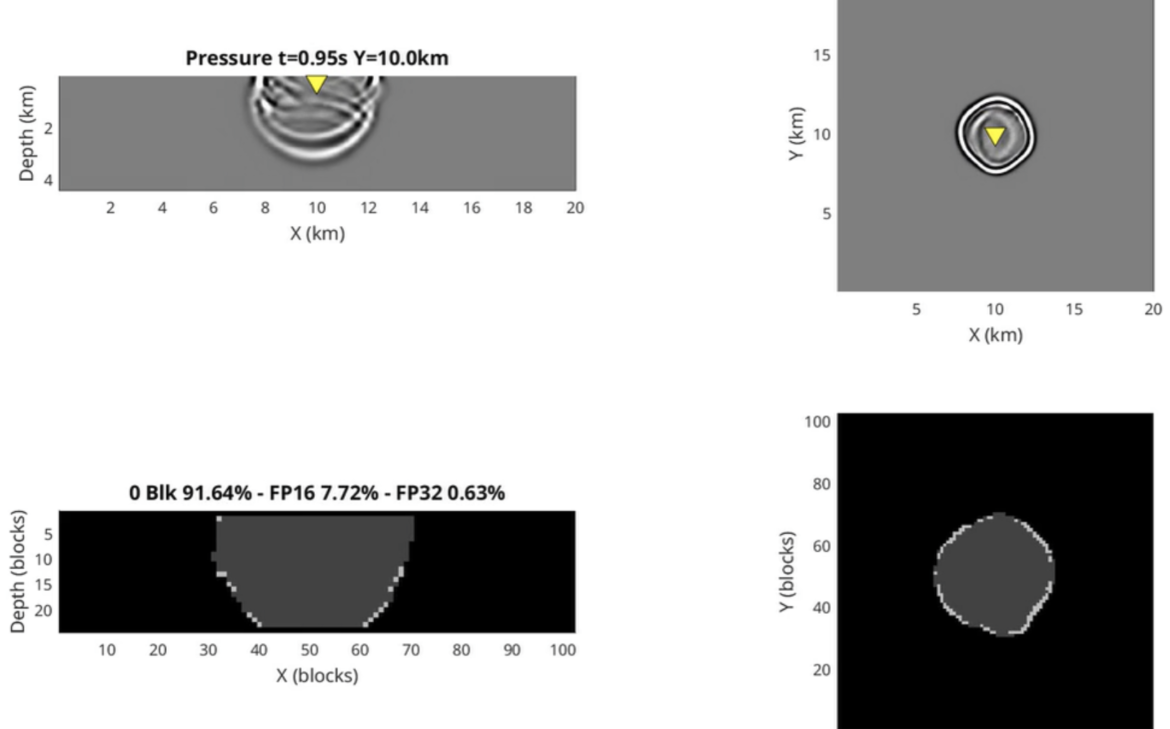
Reducing the amount of data that needs to be transferred can therefore significantly improve performance. We present our precision-adaptive block storage technique that dynamically reduces the precision of data in selected wavefield subregions whenever the numerical accuracy and application requirements permit, thereby reducing memory traffic while maintaining the required computational accuracy.

The animation shows how our approach dynamically captures the required precision (right animation) as the forward wave propagation simulation proceeds (left animation) with precision selection of blocks in red for FP32, in green for FP16, and in gray for zeros.
We deployed our approach in a seismic imaging application to reduce the overall runtime by up to 2X on an AMD Epyc 9965 192-core CPU with DDR5 memory compared to highly optimized stencil code with native FP32 storage precision. By further leveraging AlgoDoers’ custom storage formats, precision can be finely tuned to balance accuracy and performance, achieving a runtime improvement of at least 1.3X even under stringent accuracy requirements (for instance, in presence of weak events).
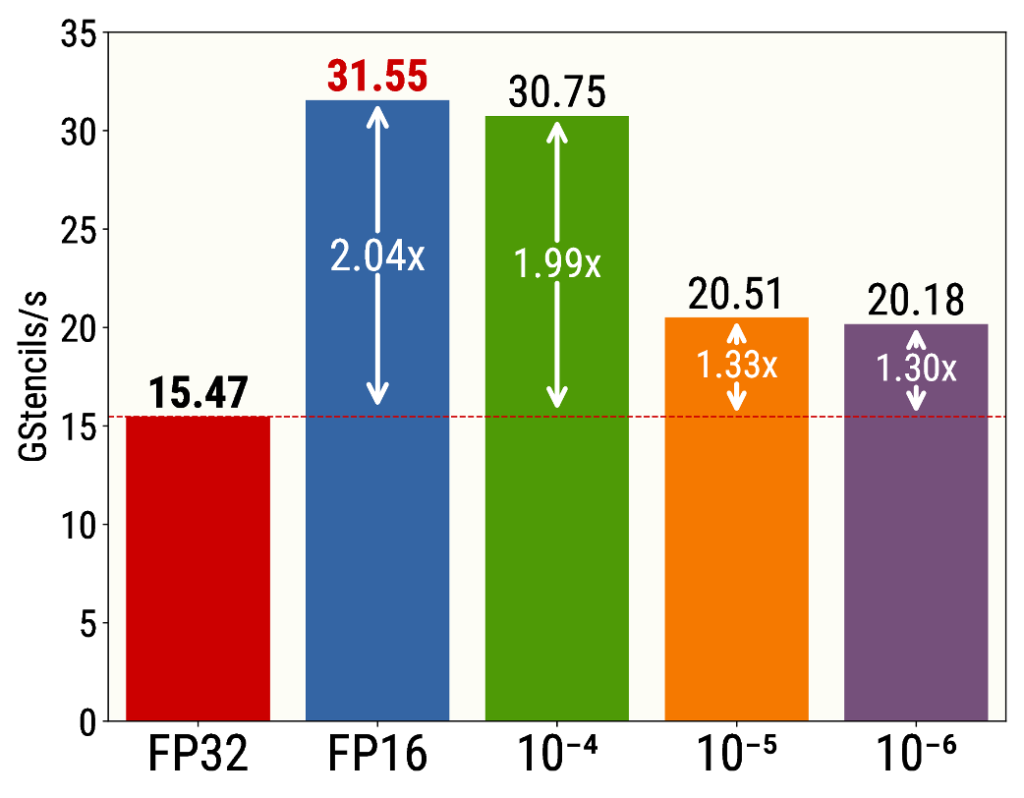
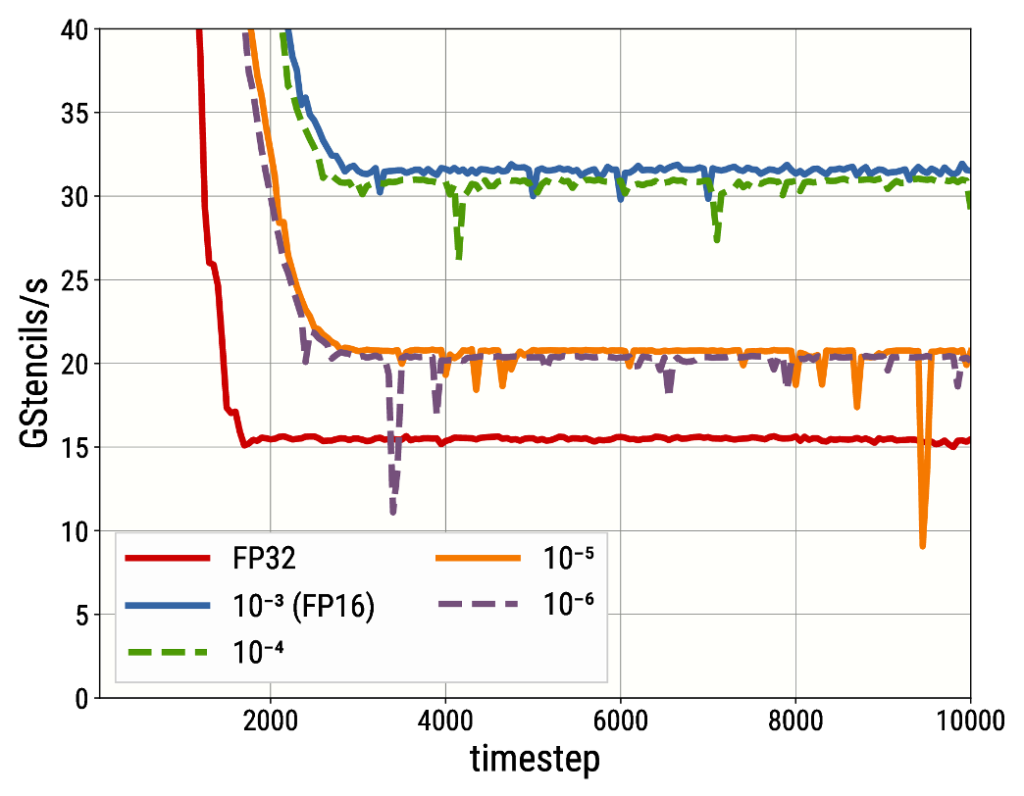
Across large-scale seismic processing campaigns, these gains translate into meaningful savings in HPC infrastructure, cloud computing, and energy consumption, while enabling geoscientists to evaluate more subsurface scenarios within the same project timeline. With AlgoDoers’ precision-adaptive block storage, we turn HPC optimization into measurable operational value—lower cost per seismic survey, faster turnaround, and more exploration insight from existing computing resources, without sacrificing the accuracy needed for decision-making.
We would like to thank AMD for the collaboration and for providing remote access to their latest hardware systems.



Leave feedback about this